- The Impact Journal
- Posts
- How this Dubai Teenager Transformed His Love for Art & Sustainability Into a Cross-Border Social Impact Project
How this Dubai Teenager Transformed His Love for Art & Sustainability Into a Cross-Border Social Impact Project
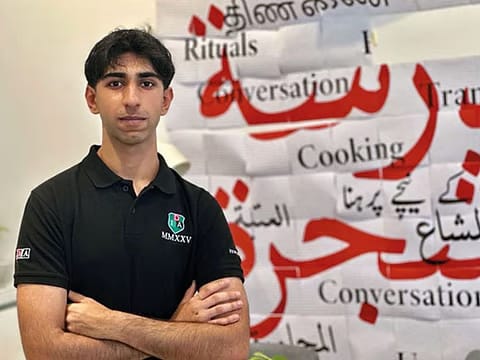
Ruhaan Malhotra is a Vanderbilt University student who grew up in Dubai. In high school, he launched Artisacs, a sustainability-focused project that turned recycled fabrics into hand-designed tote bags, with production in Delhi and outreach across Dubai.

Porte Global
January 12, 2026

Ruhaan’s project didn’t begin as a career move, it began with a family conversation.
His grandmother and mother were the first people to suggest turning his love for sketching and pop art into something tangible. Around the same time, Dubai was entering its Year of Sustainability, banning plastic bags and rolling out city-wide awareness campaigns ahead of COP28. Everywhere he looked, companies were shifting toward greener practices.
The idea clicked:
“Tote bags are something people use unanimously—they're everywhere. How can I make a change with something I love doing?”
Because his grandmother lived in Delhi and had local NGO connections, she helped him source recycled materials and supervise production: ensuring quality, transparency, and that donations reached the right people.
What began as a personal hobby became a sustainability project rooted in both Dubai and India.
If you’re a current high school student interested in starting your own initiative and standing out in university applications — you can sign up for a 30-minute extracurricular review. During the call, we'll:
a) Learn about your university goals
b) Review your extracurricular profile
c) Help you shape a unique project idea.
#1: What was high school like for you, and how did it shape your interests?
Ruhaan: High school in Dubai was incredibly fast-paced, competitive, and full of opportunity. Being at Dubai International Academy meant I was surrounded by students from everywhere in the world, all pushing themselves in different directions: academics, athletics, social good, competitions, and personal projects.
That environment mattered.
I always say you become a mosaic of the people around you, and my peers were extremely driven. Being around so many hardworking students pushed me to work harder to: not because I had to, but because I genuinely wanted to.
My teachers were also pivotal. One of my teachers, Mr. Singh, called me at 6 a.m. one day just to ask if I wanted to go to COP28. That moment said everything about my environment: if you show dedication, people open doors for you. That invitation became a turning point that helped me build confidence and gain visibility for my work.
Dubai as a city also shaped me. It’s multicultural, full of ambition, and constantly developing. Everyone around you is doing something. No one is just “chilling.” That energy rubs off on you.
#2: What inspired you to create Artisacs? How did the idea first form?
Ruhaan: It started simply: with my grandmother and mother. I’ve always been deeply into sketching and pop-art illustrations, and they suggested early on that I try to do something with my art.
At the same time, Dubai was transitioning into its Year of Sustainability. There was a plastic bag ban, COP28 was approaching, and sustainability initiatives were happening everywhere. It felt like the entire city was shifting toward environmental responsibility.
I also had a practical opportunity: my grandmother in Delhi had connections with people working in NGOs. That meant I could support a cause I cared about and figure out production realistically.
Everything lined up:
my love for art
Dubai’s sustainability push
an opportunity to create something people actually use
family support in Delhi
access to NGOs who needed the funds
Tote bags felt like the perfect intersection: widely used, practical, sustainable, and a blank canvas for art.

#3: How did you transform that idea into a fully functioning social impact project?
Ruhaan: It wasn’t quick. It wasn’t easy. And it definitely wasn’t glamorous.
Dubai has a very structured system for anything that involves public interaction or fundraising, even something non-profit like selling sustainable tote bags. So I had to rely heavily on grass-roots outreach: word-of-mouth, Instagram posts, and sharing my sketches.
The design process alone took over a year:
sketching at my desk
scanning drawings
tracing again on my sister’s iPad
cleaning and re-working the designs
During trips to Delhi, I visited textile factories with my grandmother. Seeing how recycled fabric was sorted, processed, and stitched gave me a real understanding of sustainability beyond the buzzwords. It grounded the whole project.
My school network helped tremendously too. Teachers bought bags, family friends supported the cause, and my peers shared the project organically. Eventually, I made a website to scale it further.
Artisacs grew slowly, but authentically. Every part of it was a learning curve, from manufacturing to marketing to building trust.
#4: What were the biggest lessons you learned from the entire experience?
Ruhaan: The first lesson was patience: real, long-term patience. For a year and a half, all I was doing was designing, adjusting, and preparing. I had nothing to post, nothing to sell, nothing “successful” to show. Social impact projects don’t give quick dopamine hits; you have to trust the process long before the results appear.

Newspaper Article about Ruhaan’s initiative
The second lesson was credibility matters more than anything.
When you're asking people to spend money and trust you with donations, they have every right to question where the money is going. Some were skeptical, which is fair. So I had to:
show proof
explain the process
document the NGO partnership
ensure transparency at every step
Another one was “I made my Etsy startup and got my first sale!”
My grandmother in Delhi played a key role here. She supervised production, handled quality control, and physically delivered funds to the NGO. That level of transparency built trust.
I also learned that Passion is the only thing that sustains you.
If you don’t genuinely enjoy what you’re doing, the sketches, the fairs, the messaging, you won’t last long enough to make it meaningful.
#5: Was there a specific moment or memory that stands out as the most meaningful to you?
Ruhaan: Visiting textile factories in Delhi with my grandmother is the memory that sticks with me vividly. Watching recycled materials being used, seeing the craftsmanship behind every bag, and learning how the process worked was fascinating.
But beyond that, the real emotional core was working side-by-side with my grandmother. She took ownership in ways I never expected, checking quality, supervising workers, handling financial transfers, making sure every rupee reached the NGO.
It made the project feel deeply personal.
It wasn’t just my project.
It was ours.
Those trips, the conversations, the challenges, the shared purpose, made everything feel meaningful.
#6: Now that you’re at Vanderbilt, what inspires you to continue making an impact?
Ruhaan: Being at Vanderbilt is a privilege. It’s an environment where ideas aren’t dismissed; they’re nurtured. Students are motivated, curious, and eager to build things. That energy keeps you moving.
But honestly?
I’ve always been driven by the people around me.
My friends in high school were some of the most ambitious people I’ve ever met — athletes, artists, researchers, activists. My family is extremely driven too. When the people around you are constantly striving to improve, you naturally want to push yourself as well.
Even outside social impact, I’ve found community at Vanderbilt — like the run club, which is filled with former high school athletes who didn’t get recruited. Training with them has been an “arduous experience,” as Ruhaan puts it, but it’s also motivating. Being around people who challenge themselves inspires me to keep growing.

Ruhaan Being Interviewed for his Project
Impact isn’t something I pursue for recognition. It’s just part of who I am, shaped by family, community, and environment.
#7: What advice would you give to high schoolers in Dubai who want to build their own social impact projects?
Ruhaan: My perspective is recent as I’m only two months into college but I’ll share what I’ve learned.
1. Start early, much earlier than you think.
Dubai is very safe and well-regulated, which is great, but it also means you must go through proper channels for everything. That takes time.
2. Dubai is a sandbox, use it.
There are sustainability competitions, innovation awards, school collaborations, COP events, and government-led youth opportunities all year round. High schoolers underestimate how many doors are available to them.
3. Accept that it will take a toll.
Impact projects involve doubt, skepticism, long delays, and a lot of waiting. Perseverance is crucial.
4. Don’t build a project just to impress admissions offices.
I didn’t start Artisacks for college. It became part of my application because I cared about it. College admissions teams can always tell when something is forced.
5. Understand that success is nonlinear.
You can put 40 hours into Math HL, that doesn’t guarantee acceptance to a dream school. There’s no linear formula for college results. The only thing you can control is doing work you genuinely enjoy.
If you’re a current high school student interested in starting your own initiative and standing out in university applications — you can sign up for a 30-minute extracurricular review. During the call, we'll:
a) Learn about your university goals
b) Review your extracurricular profile
c) Help you shape a unique project idea.
Stay Connected
Connect with Ruhaan: Linked-In